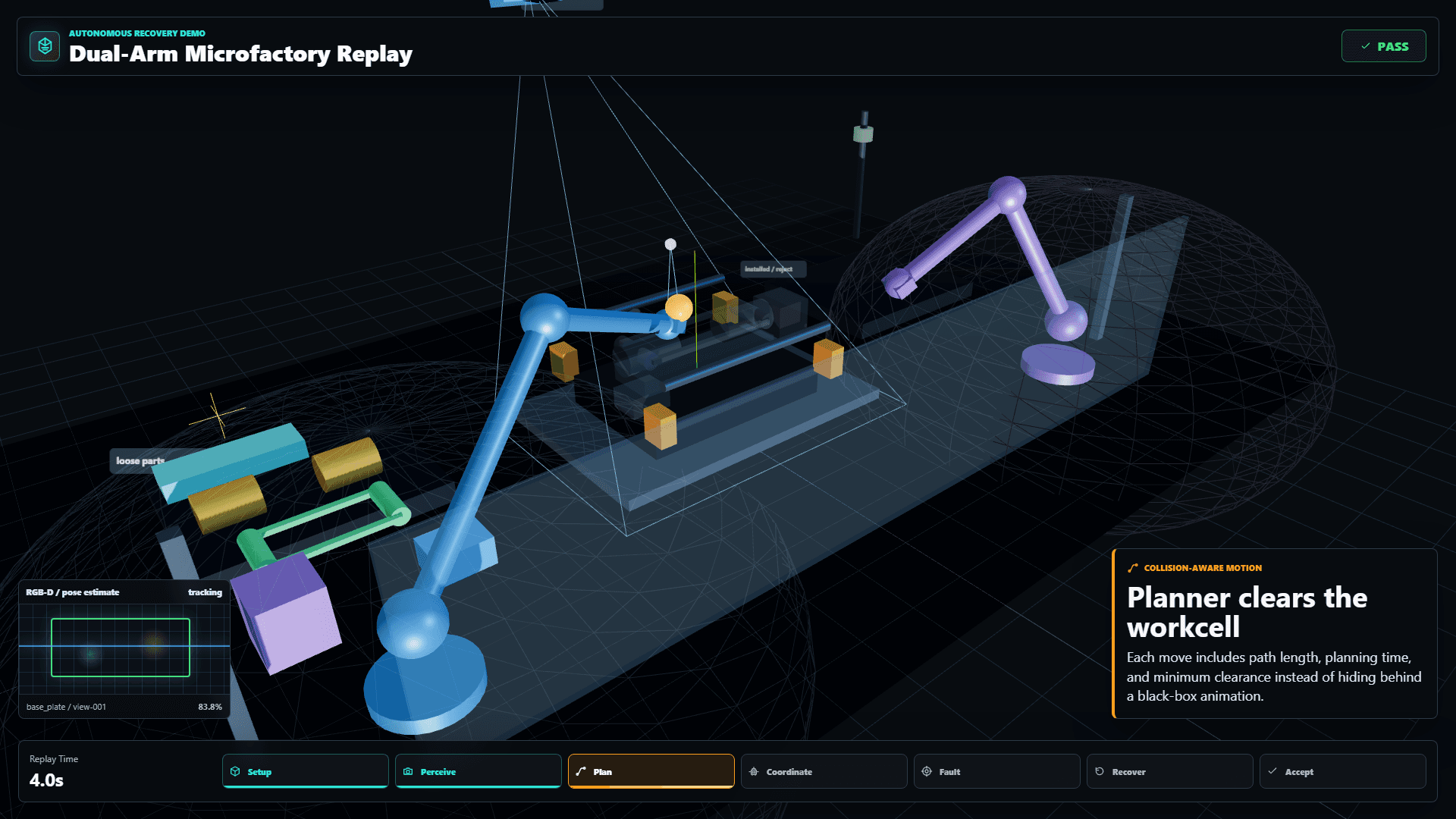
Personal Project
Dual-Arm Autonomous Microfactory
A vision-guided dual-arm assembly cell that builds, tests, and *recovers* a working mini conveyor module from loose parts — simulation-first by design, built around the hard industrial problem: understand uncertainty, recover when reality diverges from the plan, and produce evidence the cell did the right thing.
Most robotics demos show happy-path pick-and-place. This one is built around the harder problem: two arms assemble a mini conveyor from loose parts, vision identifies and pose-estimates each part, motion planning chooses collision-aware grasps, one arm holds while the other inserts — and the system intentionally encounters failures (belt slip, clamp failure, low-confidence vision) and either recovers or routes the part to reject.
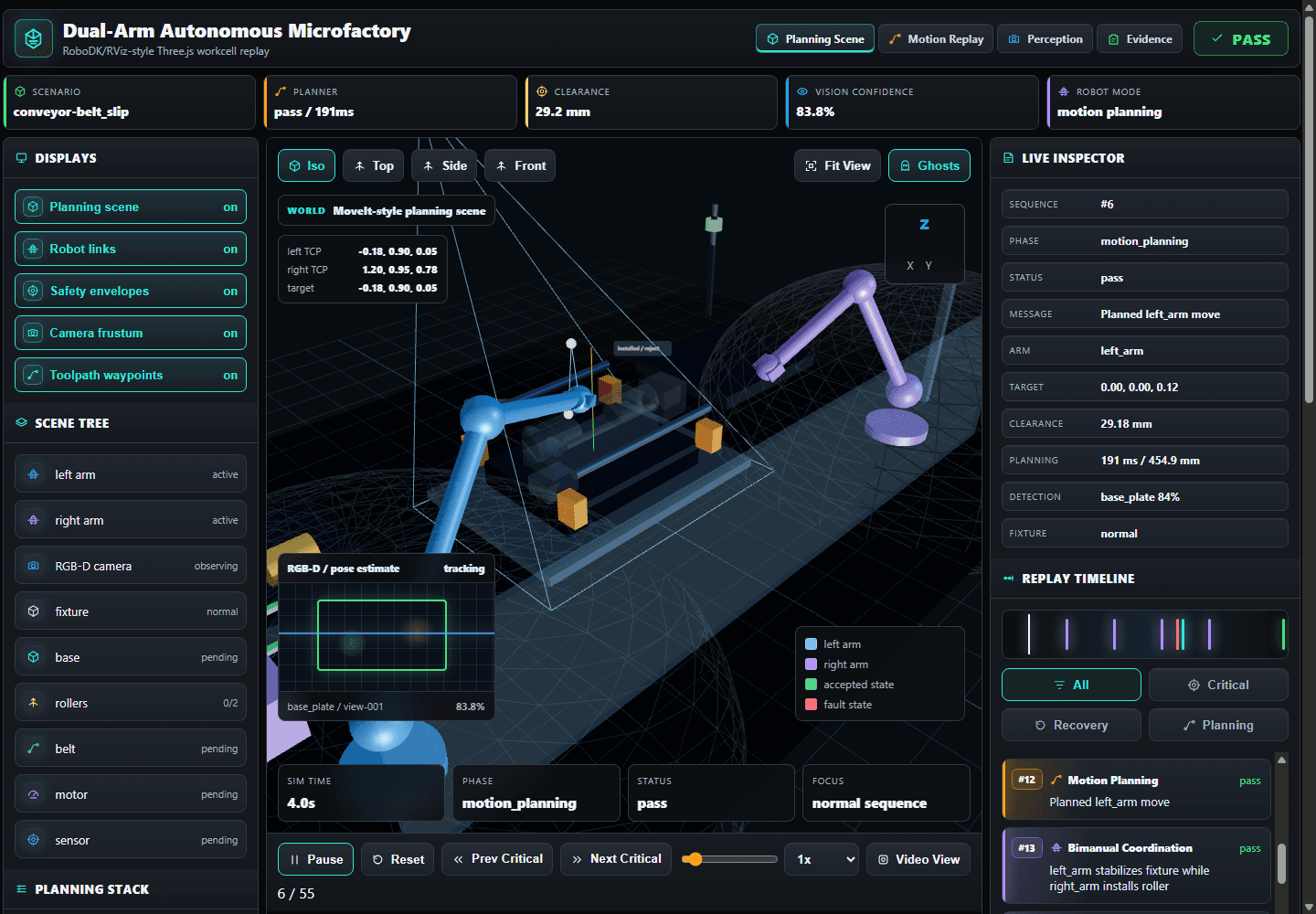
Simulation-first by design: a deterministic sim core proves the architecture, failure handling, and demo story before any hardware is bought — real robot, camera, PLC, and force-control adapters replace the simulation ports over time. This is the same pattern serious robotics teams use to de-risk a cell before wiring it.
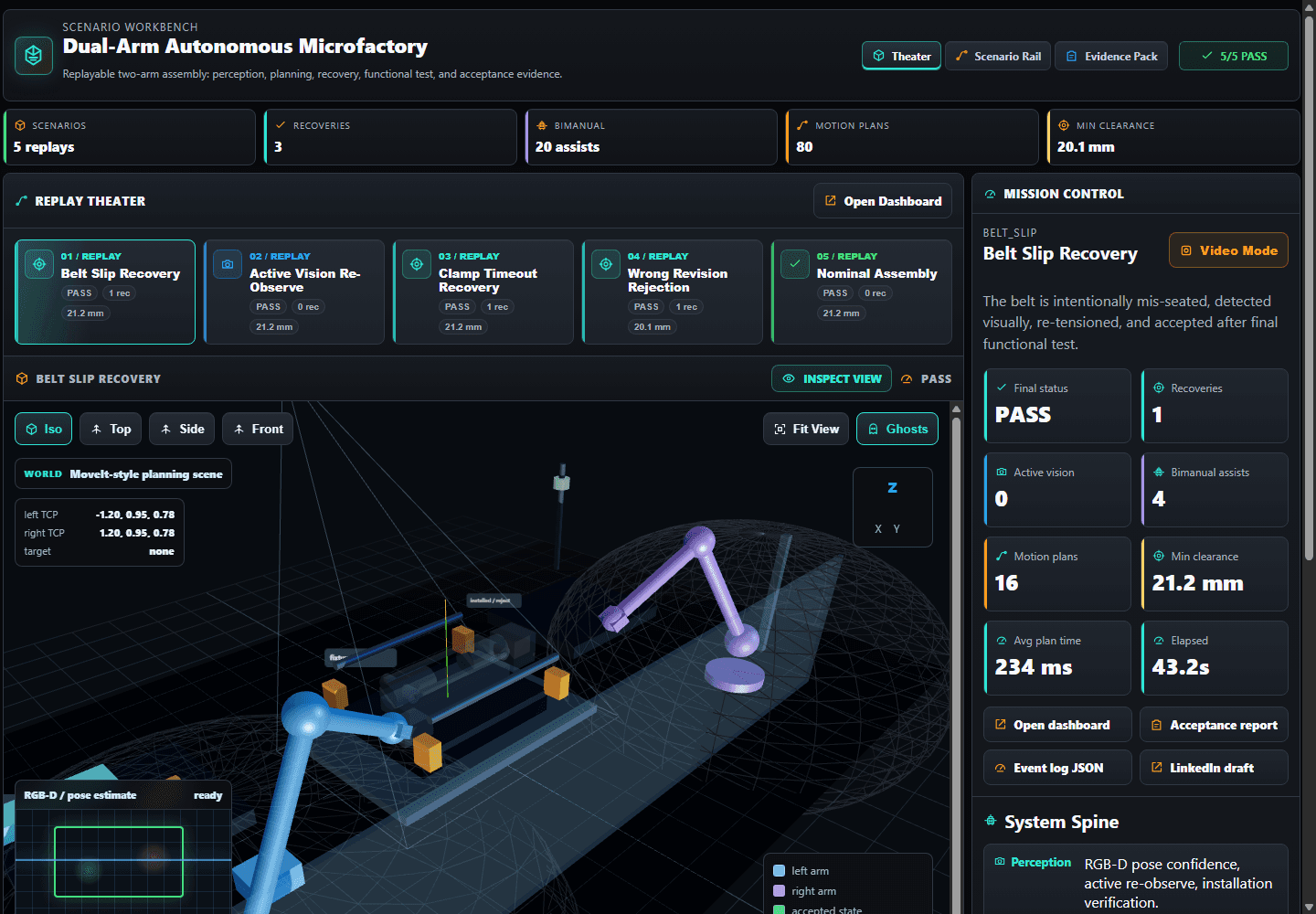
Includes active vision with confidence scoring and next-best-view retries, grasp scoring, bimanual coordination for fixture stabilization, a recovery-aware assembly controller, and a final functional test that runs the conveyor — exporting a Markdown acceptance report with a full event timeline and a RoboDK/RViz-style Three.js/WebGL viewport (grid floor, robot links, planned paths).